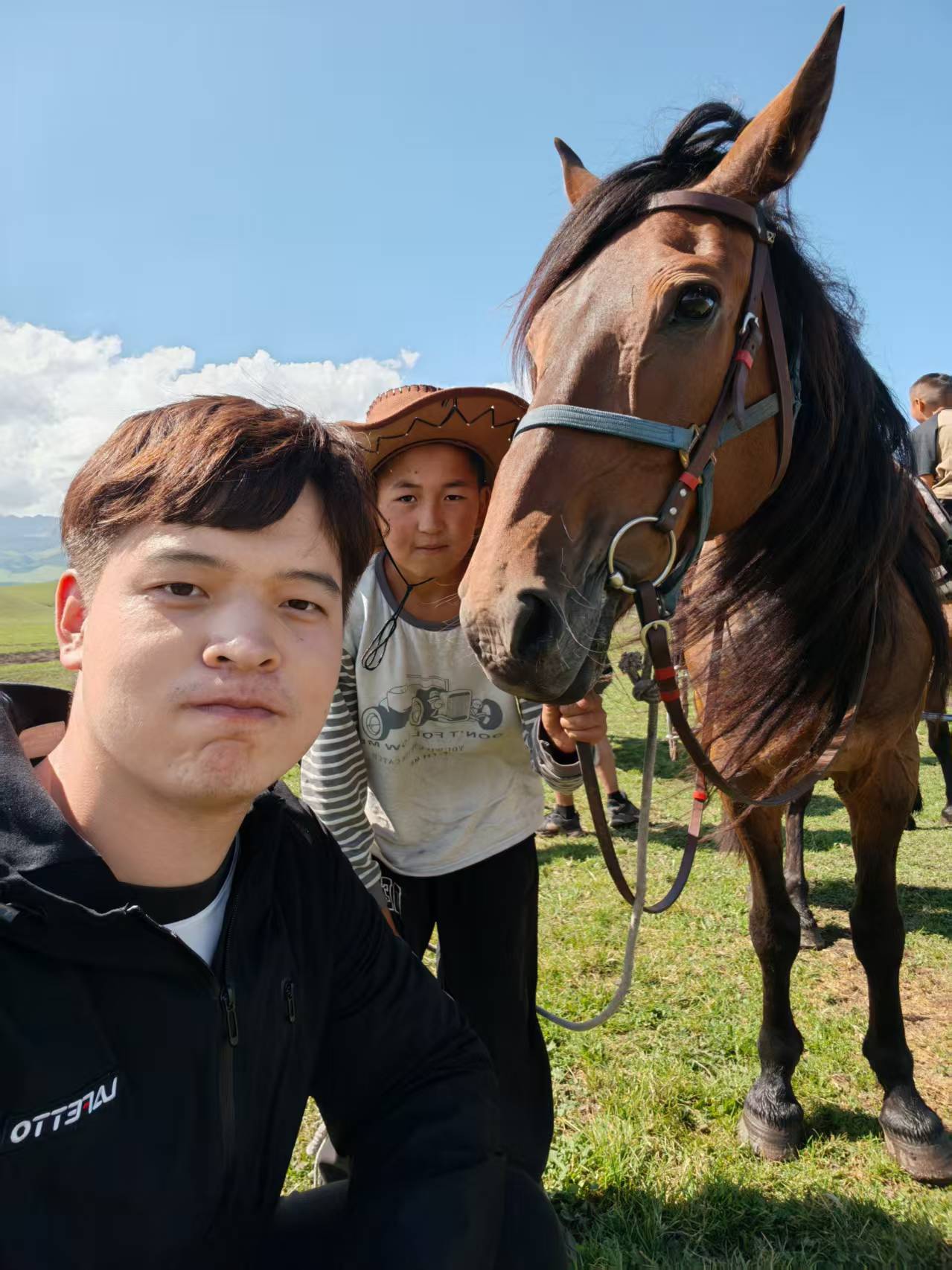
I am a master’s student in Electronic Information at the University of Chinese Academy of Sciences, working on AI for Health with a particular interest in cardiovascular AI. My research focuses on learning reliable representations from complex, noisy, heterogeneous, and incomplete biomedical data, and developing methods that are useful in real clinical settings.
I work on medical imaging and physiological signals, including prostate ultrasound segmentation and measurement, longitudinal ECG forecasting, and paroxysmal atrial fibrillation detection. Across these projects, I aim to connect robust learning with clinical needs, meaningful validation, and practical deployment. My engineering background in signal processing, physical modeling, and hands-on system building shapes how I approach these problems.
Publications and Manuscripts
NOR-TL
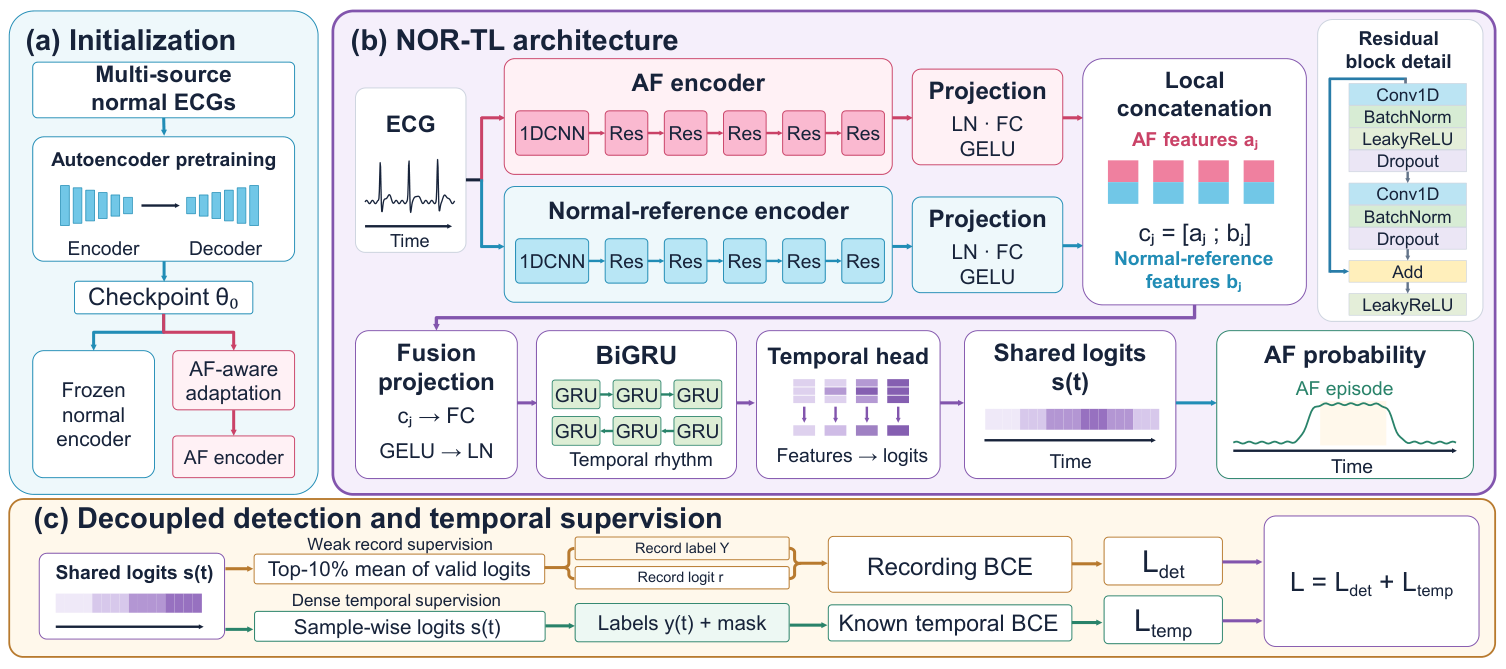
Normal-Reference Temporal Learning with Decoupled Supervision for Paroxysmal AF Detection
Learning AF detection from large recording-labeled collections and limited interval annotations. NOR-TL combines normal-reference and AF-specific features with decoupled supervision, evaluated through window-level recognition and time-point labeling on clinical-grade ECG recordings.
MIRAUS
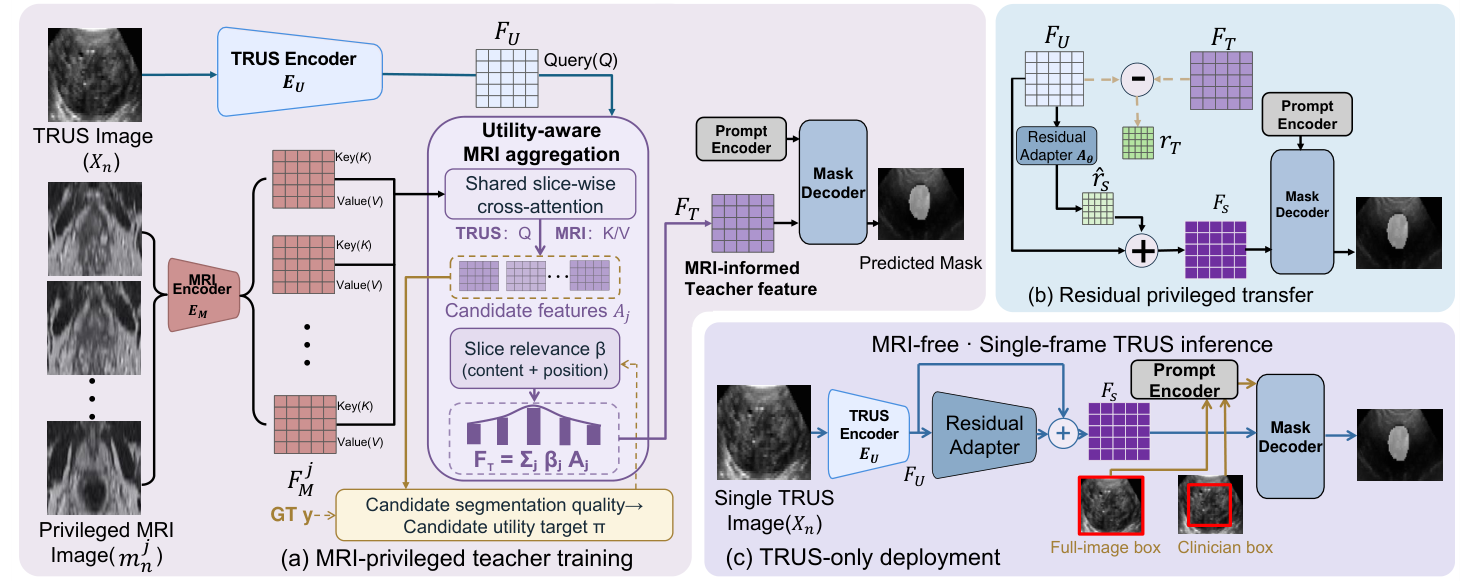
MRI-Informed Residual Adaptation for Single-Frame TRUS Prostate Boundary Measurement
Using MRI-derived anatomy during training to support prostate boundary measurement from a single ultrasound frame. The deployed model requires no MRI and supports both automatic and box-assisted inference.
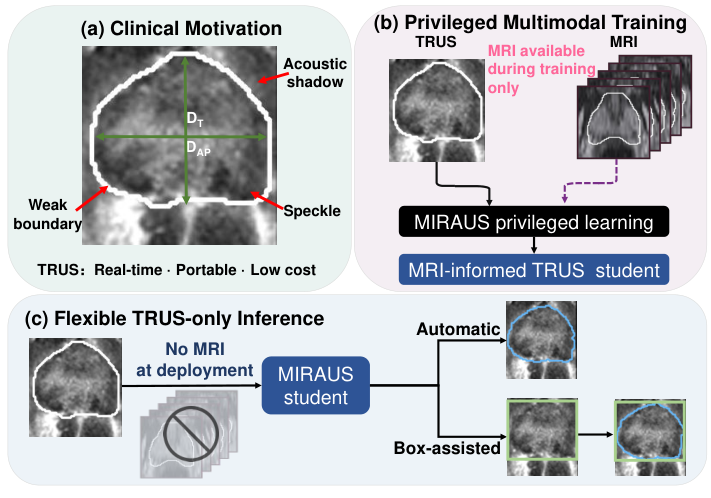 Clinical context · MIRAUS Fig. 1
PRISM
A Privileged Representation-Informed Synergistic Model for Transrectal Ultrasound-Only Prostate Segmentation
Transferring MRI anatomical information into prompt-assisted ultrasound segmentation. Privileged attention, reliability-aware fusion, and distribution alignment address weak cross-modal correspondence while keeping inference ultrasound-only.
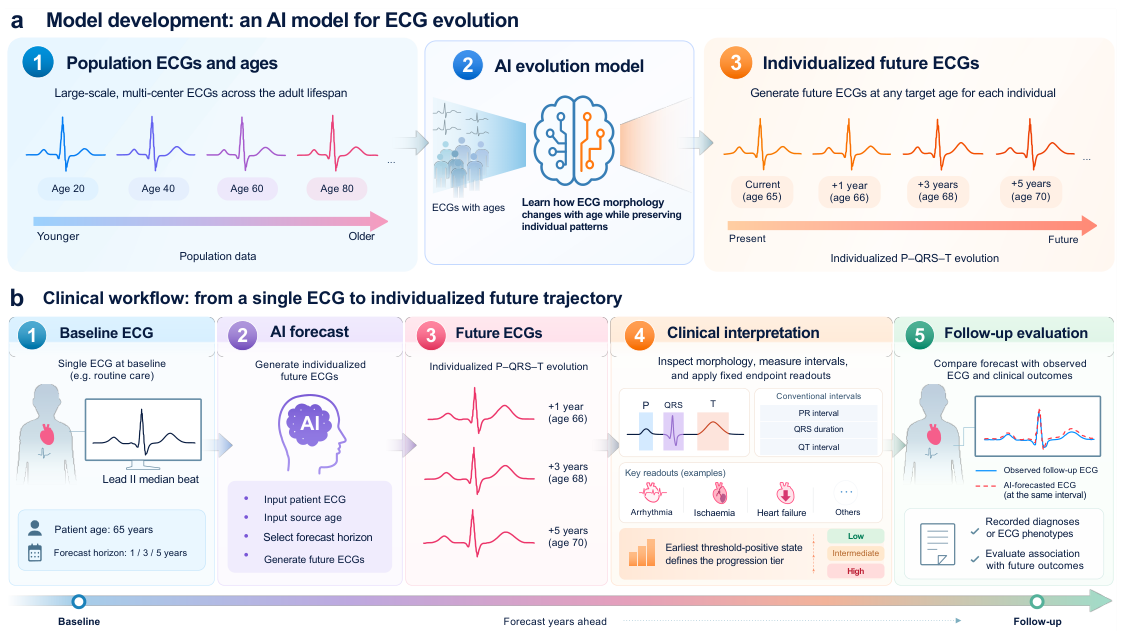
ECG FORECASTING
Individualized ECG Waveform Forecasting Enables Testable Predictions of Longitudinal Morphology
Studying individualized ECG waveform forecasts from a baseline recording, with evaluation focused on longitudinal morphology. My contributions include data curation, waveform analysis, and validation.
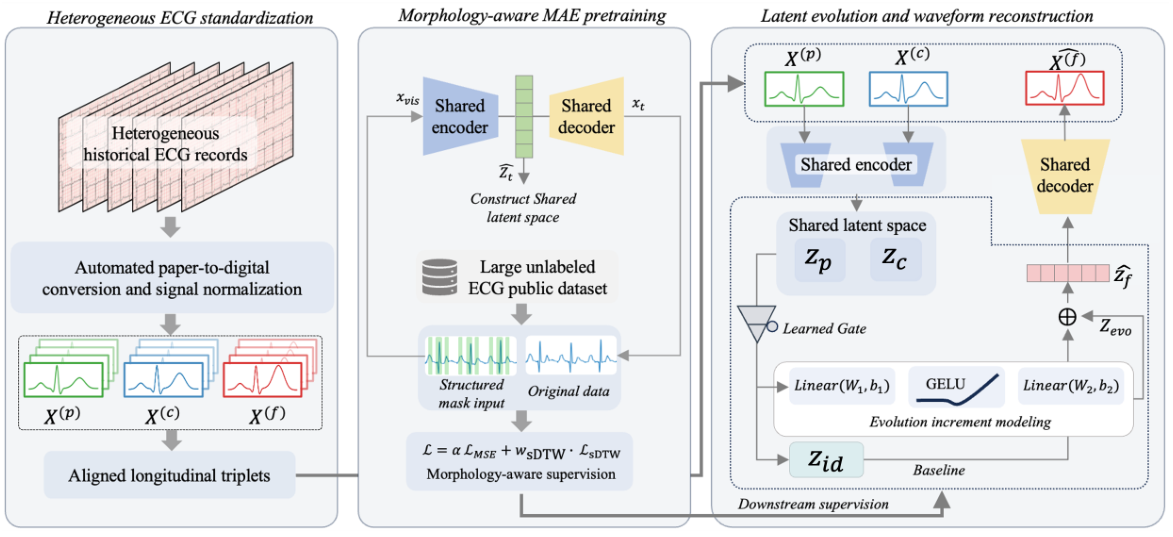
LONGITUDINAL ECG
A Cross-Temporal Latent Evolution Framework for Year-Scale ECG Waveform Forecasting from Historical Records
Investigating year-scale ECG waveform forecasting from historical recordings. This work examines longitudinal morphology and progression-sensitive changes, supported by my contributions to data processing, analysis, and validation.
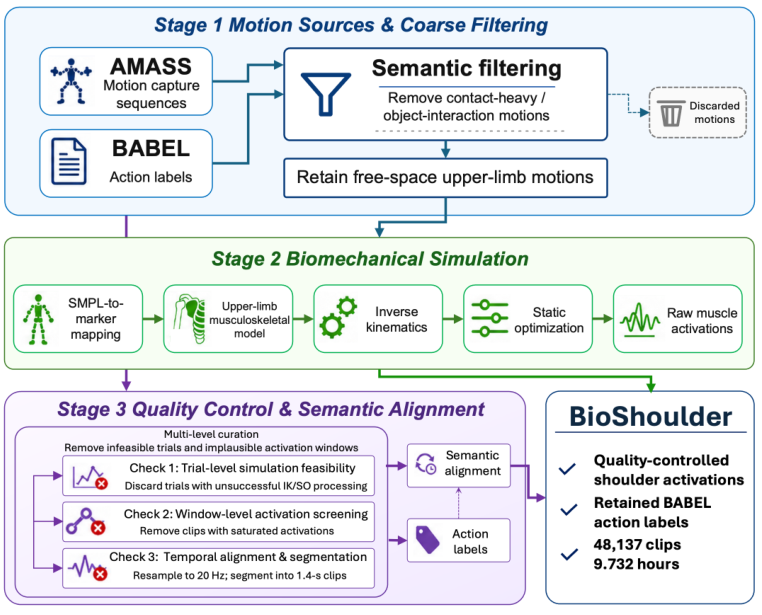
BIOSHOULDER
A Large-Scale Biomechanical Dataset for Shoulder Muscle Activations
A dataset of quality-controlled, simulated shoulder muscle activations derived from human motion. It combines motion curation, musculoskeletal simulation, and activation screening, with benchmarks for motion-to-muscle prediction.
Research and Engineering Experience
- 2025.08 – Present, Individualized ECG Waveform Forecasting - University of Chinese Academy of Sciences; clinical collaborators: Fuwai Hospital and Aerospace Center Hospital, Beijing. Built preprocessing and representation-learning pipelines for over one million public ECG records and over 100,000 hospital recordings; contributed to waveform evaluation and follow-up analysis across two longitudinal forecasting studies, including a clinical subset of 959 participants; contributed to NSFC General Program and Beijing Natural Science Foundation proposal preparation.
- 2026.04 – 2026.09, NOR-TL: Paroxysmal AF Detection - University of Chinese Academy of Sciences; clinical collaborator: Aerospace Center Hospital, Beijing. Developed normal-reference and AF-specific ECG representations with decoupled supervision: weak recording labels guide pooled detection, while interval annotations supervise sample-wise predictions. Evaluated window-level recognition and time-point detection on public, clinical-grade AFDB and external LTAFDB and CPSC2021 recordings with patient- or recording-disjoint partitions. Achieved 98.0% temporal AUROC and 0.838 time-point MCC on 1,425 CPSC2021 recordings. First-author manuscript submitted to ICASSP 2027.
- 2024.09 – Present, Privileged Learning for Prostate Ultrasound Segmentation and Measurement - developed PRISM and MIRAUS to use MRI-derived information during training while retaining TRUS-only inference; evaluated patient-disjoint segmentation, external generalization, and model-derived calipers for conventional ellipsoid volume estimation; contributed to manuscript writing and grant proposal preparation for a NSFC Regional Science Fund project.
- 2025.04 – Present, Biomechanical Simulation and Physical Orthopedic Modeling - constructed an ANSYS model of humeral motion using physiological movement constraints; compared simulated kinematics and force responses with collaborator measurements; designed and built a physical orthopedic model to reproduce humeral motion for bench-scale validation. Co-authored BioShoulder, a dataset of simulated shoulder muscle activations, as part of this broader shoulder-biomechanics collaboration (third author).
- 2024, Deep Learning-Based Underwater Acoustic Channel Estimation - investigated deep learning methods for underwater acoustic channel estimation in noisy and time-varying conditions, with a focus on signal processing and experimental evaluation.
- 2023.08 – 2023.09, South China Sea Survey Center, Ministry of Natural Resources of the People’s Republic of China - assisted buoy operations, including GPS and CTD sensor deployment and recovery, data reception, and cloud-based data uploading.
- 2023 – 2024, National Marine Vehicle Design and Manufacturing Competition - participated in AUV modification, underwater testing, troubleshooting, and competition presentation; received Third Prize in the South China regional contest.
- 2022, Tracked ROV Mechanical Design - led the design of a tracked remotely operated vehicle; completed 3D modeling, motion simulation, and prototype fabrication using SolidWorks, COMSOL, CATIA, and 3D printing.
Education
- 2024.09 – Present, Master’s studies in Electronic Information, University of Chinese Academy of Sciences, Beijing, China. Research university of China’s national academy of sciences; ranked 54th globally and 5th in China (U.S. News 2026).
- 2020.09 – 2024.06, Bachelor of Engineering in Marine Engineering and Technology, Sun Yat-sen University, Guangdong, China. National research university under China’s Ministry of Education; ranked 85th globally and 8th in China (U.S. News 2026).
Honors and Awards
- 2026: Second-Class Academic Scholarship, University of Chinese Academy of Sciences.
- 2026: Merit Student, University of Chinese Academy of Sciences.
- 2024: Third Prize, South China Regional Contest, 12th National Marine Vehicle Design and Manufacturing Competition.
- 2021: Merit Award, Sun Yat-sen University Experimental Skills Competition.
- 2021: Outstanding Team Member, Sun Yat-sen University Admissions Outreach Association.
Skills
- Programming: Python, MATLAB
- Research: Deep learning, ECG signal processing, time-series modeling, medical image analysis
- Engineering: SolidWorks, AutoCAD, CATIA, COMSOL, Arduino, 3D printing
- Languages: Mandarin Chinese (Native); English (CET-6, Intermediate)